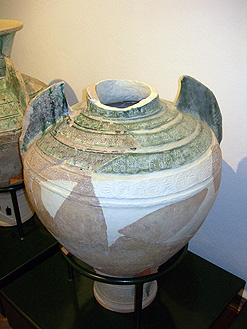
Name: Water pot with glaze and stamped decoration
Provenance: Citadel of Mértola
Location: Museum of Mértola - Islamic Art.
Chronology: Second half of the 12th century / first half of the 13th century
Description: A pot intended to carry water, broken at the rim. It features a cylindrical neck, globular body with two triangular vertical handles, flat walls and base. The vessel is partially coated with an outer layer of green glaze. It is decorated with a series of Hamsa (hands of Fatima) stamped on the clay while it was still fresh. The pot has a stand which gave it stability, but mostly was used to gather spills, pouring them into another container through a spout.
Dimensions: Max. height 70cm; Max. width 53cm.
Decoration: A stamped horizontal pattern shows the following motifs under the glaze: Hamsa, vegetable elements and eight-pointed star.
The figure shows the Hamsa with five open fingers, relating to the five Pillars of Islam - faith, prayer, fasting, charity and pilgrimage - the mandatory ritual rites which identify the Muslim faith.
In these objects, as with others, in addition to its function as an amulet and talisman the Hamsa also serves to attain spiritual protection.
This "talisman" was named in honour of Fatima, daughter of the Prophet Muhammad.
Bibliography:
KHAWLÎ, Abdallah; “Introdução ao estudo das vasilhas de armazenamento da Mértola islâmica”, Arqueologia Medieval 2, Mértola / Porto, CAM / Afrontamento, 1993,
pp. 63-78, pp. 68-69.
IDEM, “A Mão de Fátima e a sua representação na arte hispano-muçulmana. Cerâmica Estampilhada de Mértola”, Actas do Encontro ‘Arqueologia en el entorno del Bajo Guadiana’, Universidade de Huelva,
1994, pp. 605-618.
MAÇARICO, Luís; “A função antropológica da aldraba: da origem simbólica à morte funcional”, Arqueologia Medieval 8, Mértola / Porto, CAM /Afrontamento, 2003, pp. 301-312.
TORRES, Cláudio; MACIAS, Santiago (coord.) - Museu de Mértola : arte islâmica: guia do museu. Mértola: Campo Arqueológico de Mértola, 2003.